An Original Novel
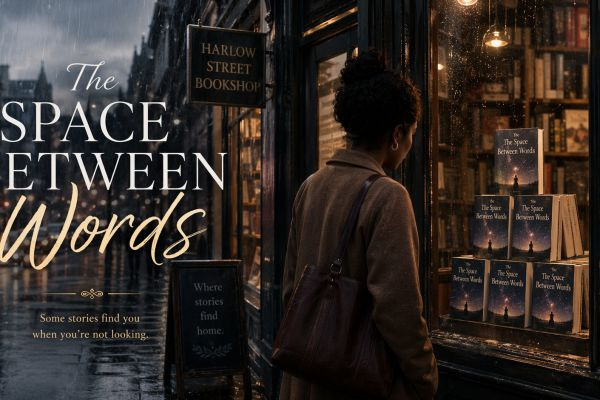
The Space Between Words
A love story told in six chapters. London. A borrowed umbrella. Two people who had both been looking for the same book.
Chapter One
The Wrong Umbrella
The rain started the way most things that change your life do — without warning and at the worst possible moment.
Celeste Adeyemi had been standing outside the Harlow Street Bookshop for four minutes, which was exactly three minutes and fifty seconds longer than she had intended to pause there. She had simply glanced in the window — a habit, not a decision — and had seen the display: a stack of the novel she had been looking for across six different shops for the better part of three weeks, arranged in a pyramid of modest triumph, spine facing outward, the title catching the light.
She was through the door before she had consciously agreed to it.
The bookshop smelled the way all good bookshops should: of paper and dust and the particular quiet that accumulates between shelves over decades. A cat slept on the counter beside the register. A man at the far end of the biography section was reading standing up, which Celeste considered the truest sign of a person who genuinely loved books.
She found her novel. She paid for it. She stepped outside and walked directly into the rain, which had decided in her six minutes of absence to become the kind that does not mess around.
She had no umbrella.
She pressed herself against the awning, which was more decorative than functional, and weighed her options. She was due at her sister’s flat in twenty minutes. She was also, she noticed, sharing the awning with a man who had emerged from the bookshop approximately four seconds after her, carrying a bag that clinked with the particular sound of multiple hardcovers, and who was now standing two feet to her left looking at the rain with the resigned expression of someone who had done this before.
He was carrying an umbrella. He had not opened it.
“You know you have one of those,” she said, because she could not help herself.
He looked at the umbrella as if noticing it for the first time. He looked at the rain. He looked at her.
“I do know,” he said. “I was working up to it.”
“The rain is not going to wait.”
“The rain,” he said, “does seem fairly committed.” He opened the umbrella. It was large and dark green and unexpectedly elegant. He tilted it toward her without making a ceremony of it. “I’m going left.”
“I’m going right.”
“Of course you are.”
They stood for a moment in the specific social negotiation of two strangers choosing between inconvenience and kindness. The umbrella was large enough for two. Neither of them said this.
“I’ll be fine,” she said.
“You’ll be soaked,” he said.
“I’ll be fine and soaked.”
He smiled at that. It rearranged his face in a way she noticed and decided not to think about.
“I’m Daniel,” he said, holding the umbrella steady between them.
“Celeste,” she said, and stepped under it.
They walked right. They did not discuss this. The rain was loud on the canopy of dark green above them, and the street was quiet because everyone sensible was inside, and they walked close together because the umbrella required it, and for three blocks neither of them said a word.
“What did you buy?” he asked.
She showed him. He stopped walking.
“I’ve been looking for that for three weeks,” he said.
She stared at him. “So have I.”
“Six different shops.”
“Six,” she agreed.
They stood in the rain under the green umbrella and looked at each other with the particular expression of people who have just discovered an implausible coincidence and do not yet know what to do with it.
“I could have bought the last copy,” he said.
“You didn’t.”
“There were two left.”
“Then there is still one.”
He looked back in the direction of the bookshop. The rain intensified. He looked at her. She was holding her book against her chest with both hands, keeping it dry, the way people hold things they have wanted for a long time.
“I’ll get it tomorrow,” he said.
They walked the remaining two blocks to her sister’s building in a companionable silence that felt, she thought later, entirely too natural for two people who had met nine minutes ago in the rain.
At the door, she stepped out from under the umbrella. The rain caught her immediately, cold and specific as a statement.
“Thank you,” she said.
“The umbrella stays with you,” he said. “It’s raining harder.”
“I can’t take your umbrella.”
“You can return it,” he said. “Same bookshop. Saturday morning, usually, around ten.”
He said it lightly, as though it were a casual arrangement and not, as she would think about it later on the train home with the dark green umbrella propped beside her seat, an invitation.
She was holding her book against her chest with both hands, the way people hold things they have wanted for a long time.
Chapter Two
Saturday
She went to the bookshop on Saturday. She told herself it was to return the umbrella. She told herself it had nothing to do with him. She had borrowed a stranger’s umbrella. There were social obligations that had nothing to do with brown eyes and a smile that rearranged things. This was simple courtesy.
She arrived at five past ten, because arriving at ten exactly would have seemed deliberate.
He was already there, standing in the same biography section, reading standing up. He had the novel in his hand — her novel, the one they had both been looking for — and he was twenty pages in.
“You found it,” she said.
He looked up. He did not seem surprised to see her, which she found both relieving and annoying. “I did. There was one left.” He held it up. “It’s good.”
“You’re only twenty pages in.”
“Twenty very good pages.”
She set the umbrella on the counter beside the sleeping cat. “I came to return that.”
“I know,” he said. He went back to his book.
She stood in the bookshop for a moment, aware that she had fulfilled her stated reason for being there and was still there, and that he had not given her any particular reason to stay, and that she was staying anyway, moving to the shelves and pulling a spine out at random just to have something to do with her hands.
After a few minutes he said, without looking up, “Are you actually reading that or are you just holding it?”
She looked at the book in her hands. It was a volume on nineteenth-century watercolour techniques. “Reading it,” she said.
“You’re holding it upside down.”
She turned it around. “Better.”
He laughed. It was an unguarded laugh, the kind that comes before a person has decided whether a thing is funny, which meant he had not had time to perform it, which meant she trusted it.
“Coffee?” he said.
They went for coffee. The rain had stopped. The coffee place was three doors down and had small wooden tables and mismatched chairs and radio playing something from the 1960s that neither of them could name. They sat for two hours.
She learned: he was an architect, specialising in school buildings; he had grown up in Bristol and moved to London at twenty-three; he had a sister named Priya who was a doctor; he still found certain things about the city — the rush, the noise, the way no one met eyes on the tube — mildly baffling.
He learned: she was a translator, specialising in literary fiction, French and Italian to English; she had grown up between Lagos and London; she had a sister named Adaora who was the person she had been going to visit in the rain; she had been in this neighbourhood for three years and still felt, pleasantly, that there was more of it to know.
They talked about architecture and translation and the things each of their jobs required you to believe in — that buildings could change how people felt, that words could survive crossing from one language to another. On the question of whether translated literature was ever quite the original thing, they disagreed with the particular engagement of two people who have found someone worth disagreeing with.
At noon she looked at the time and said she had to go. He did not ask for her number. She did not offer it.
At the door she turned back and said, “Same bookshop. Next Saturday?”
“I’ll be there,” he said.
It was an unguarded laugh, the kind that comes before a person has decided whether a thing is funny — which meant she trusted it.
Chapter Three
The Thing About Familiarity
By the fourth Saturday they had a table. Not assigned, not discussed — simply the small corner table by the window at the coffee place that they had occupied twice before and that was, both times they arrived, empty, which they treated as fate and said nothing about.
By the sixth Saturday she knew that he took his coffee with no sugar and a small amount of milk added after, that he always read the last page of a book before buying it which she found intellectually indefensible, and that when he was thinking hard about something he went very still in a way that made the space around him quiet.
By the eighth Saturday she had stopped telling herself this was casual.
She told Adaora about him on a Tuesday evening over dinner.
“You’ve been seeing this person every Saturday for two months,” Adaora said, “and you haven’t kissed him.”
“We haven’t been seeing each other. We’ve been —”
“Meeting. Getting coffee. Talking. Yes. Celeste.” Adaora put her fork down with the gentle precision of someone making a point with crockery. “That is called seeing someone.”
“It’s a standing arrangement.”
“So is a relationship.”
The thing was — and Celeste had thought about this on the tube, on walks, at her desk with a half-translated chapter open in front of her — the thing was that she was not sure she had ever liked anyone the way she liked Daniel Osei, which was precisely why she was afraid of what would happen if she said so. She had been in love before. She knew how it went. You said the thing, and the thing either landed and changed everything, or it didn’t land and changed everything in the other direction. Either way things were irrevocably different from before you said it, and she had come to value what she had with him too much to risk it carelessly.
The next Saturday he was there when she arrived. He was already at the table and he had brought her coffee, which meant he had arrived early enough to order for both of them, which meant he had been thinking about this.
She sat down. She looked at the coffee. She looked at him.
“You’re here early,” she said.
“I wanted to be,” he said.
The radio was playing something slow and unremarkable. Outside the window, people moved past with the forward momentum of Saturday mornings.
“I’ve been thinking,” he said, “that I don’t want to keep pretending this is just coffee.”
The radio played. The street moved.
“It’s very good coffee,” she said, and watched him laugh, and thought: this. This specific thing. His face when he laughs.
“Celeste.”
“Daniel.”
“Tell me what you’re thinking.”
She picked up her coffee. She set it down. She looked at him with the directness she had learned from years of working with language — the understanding that clarity, even when it costs something, is always kinder than ambiguity.
“I think,” she said carefully, “that I have been looking forward to Saturdays with a frequency and intensity that has nothing to do with the coffee.”
He reached across the small table and put his hand over hers.
“Me too,” he said.
Outside the window London went about its Saturday business, entirely indifferent to the two people at the corner table whose whole arrangement had just quietly shifted into something new.
Outside the window London went about its Saturday business, entirely indifferent to the two people at the corner table whose whole arrangement had just quietly shifted into something new.
Chapter Four
What Gets Said in the Dark
Three months in, they had dinner instead of coffee. Then dinner became a habit. Then the habit became the thing they built their weeks around. She learned the geography of his flat — the architectural drawings pinned to the wall of his study, the particular chaos of his bookshelf which he defended as organisational and was not, the way the kitchen window caught the late afternoon light in October in a colour she could not have named but would have recognised anywhere.
She was translating a novel about a woman who could not say the thing she meant, and she was aware, in the particular doubled consciousness of a literary translator, of the irony in this.
“The problem,” she told him one evening, lying on his sofa with her feet in his lap and her laptop open, “is that she keeps finding the almost-word. The word that is next to what she means but is not it. And I am supposed to find the equivalent almost-word in English, and English has different almost-words, and the gap between the original almost-word and the English almost-word is where the book lives.”
“Where the book lives,” he repeated. He had been drawing in his sketchbook. He set it down. “That’s the whole thing, isn’t it. The space between what you mean and what you say.”
“In translation, yes.”
“In everything,” he said.
He told her about growing up in a house where people said the practical thing instead of the real thing. His father was not unkind. He was literal. If something was wrong, he fixed it. The emotional register was very compressed. He thought he had spent a long time learning to read what people meant rather than what they said.
“Is that why you’re an architect?”
He considered this seriously. “Maybe. You can say a great deal with a building that you can’t say out loud. How a room is lit. How wide a corridor is. Whether a window faces the thing worth looking at.”
“What does your flat say?”
He looked around the room — the books, the drawings, the kitchen window and its October light. “I think it says: someone lives here who is trying to make a space that feels like the inside of his head.”
“Does it?”
“Not yet,” he said. He looked at her. “It’s getting closer.”
Later that night, in the dark, she said: “I love you.”
She had not planned it. It arrived the way the rain had — without warning, at an unexpected moment, already committed before she had agreed to it.
He was quiet for long enough that she thought she had miscalculated everything.
Then he said, very quietly: “I know. I’ve known for a while.” A pause. “I love you too. I’ve been waiting for the right word.”
“That was the right word,” she said.
“It was the only word,” he said.
It arrived the way the rain had — without warning, at an unexpected moment, already committed before she had agreed to it.
Chapter Five
Distance
The offer came in January, which was the cruelest month for bad news because January already had so little to recommend it.
It was a commission — the most significant of his career. A school complex in Accra, designed from the foundation up with the intention of becoming a model for educational architecture across West Africa. Two years. His firm. His lead.
He told her on a Friday, not their Saturday, because it had arrived on Friday and he had not wanted to wait. She knew from the way he said it that he had already said yes in his head and was only now saying it to her, and that he was afraid of what she would say, and that he wanted her to say it was fine.
She wanted to say it was fine.
“Two years,” she said.
“Roughly. With visits.”
She did not say: that is not the same as here. She did not say: I have arranged my life around Saturdays with you and Saturday is not a trip on a calendar. She did not say any of the things she was thinking, because she recognised them as her own fear dressed up as reason.
“This is what you do,” she said. “This is the thing you believe in.”
“Yes,” he said.
“Then you have to go,” she said. “I will be very unhappy about it and we will figure it out and you have to go.”
He crossed the room and held her face in his hands and said nothing for a long moment, which said everything.
The first month was the hardest. She translated furiously, working through a backlog she had been building for months, filling the time that had previously been him with words that belonged to other people’s stories. She called him on Sundays. He sent her photographs of Accra — the light there, which was different from London light in ways she had not predicted, and the building site in its early stages, which looked like nothing yet but which she was learning to look at the way he had taught her: not as what it was but as what it was becoming.
She missed him with a physicality that surprised her. Not abstractly. Specifically — the quality of his presence in a room, the stillness when he thought, the laugh that arrived before he had decided something was funny.
“You know this is the one, right,” Adaora said. “When it’s this hard to have them gone.”
“I know,” Celeste said.
“So?”
“So I wait. And I translate. And on Sundays we talk for two hours.”
She sent him the novel she had finished translating, with a note on the title page: this is what it is to almost say the thing and not quite. You should read it.
He read it in a week and called her and said: “She finds the word in the end. Did you know that going in?”
“I knew it was there. I had to find it in English.”
He was quiet for a moment. “I’m coming home in six weeks.”
“I know.”
“I’m going to take you back to the bookshop. And then to the coffee place. And I’m going to sit at that table for a very long time.”
“The table might be taken.”
“Then we will stand,” he said, “until it isn’t.”
She missed him not abstractly but specifically — the quality of his presence in a room, the stillness when he thought, the laugh that arrived before he had decided something was funny.
Chapter Six
The Space Between Words
He came back in March. She was at the bookshop at ten, which was not casual and she had given up pretending otherwise. She was standing in the window display section, not looking at books, when the door opened and he came in.
He was the same. He was different in the way that people are different after they have spent eighteen months doing the thing they were built to do. Something settled in him that had previously been in motion.
She did not say anything. Neither did he. He crossed the shop and she met him halfway, which seemed, later, like the right description of everything.
They went to the coffee place. The small corner table by the window was, implausibly, empty. They sat. The radio played something slow and familiar.
He took out his sketchbook. She had seen his drawings before but these were different — more feeling in the line, as if the distance had loosened something.
“You’ve changed how you draw,” she said.
“I’ve changed how I see,” he said.
“Daniel.”
“Yes.”
“I’ve been thinking about something.”
He went still in the way he went still.
“I translate from French and Italian,” she said. “Those languages exist in many places. Including Accra.”
The street outside moved with its Saturday morning business.
“There’s a literary scene there,” she said. “Growing. Francophone West African fiction is some of the most interesting work being done right now, and there is not nearly enough of it translated into English. I have thought about this for several months and it is not only about you, although it is also about you.”
“Celeste.”
“I’m asking if there would be room for me.”
He did not answer immediately, and she respected him too much to fill the silence, and she waited.
“I drew something,” he said.
He turned to the back of the sketchbook. It was not a building. It was a room — a study, lit by a window positioned to catch morning light. Two desks, facing different walls. Bookshelves that consumed one entire side. A window seat. The proportions were generous without being grandiose. It was the kind of room designed for two people who needed quiet and proximity in equal measure.
“I drew this in November,” he said. “I didn’t know what to do with it.”
She looked at the drawing for a long time.
“You drew it in November,” she said.
“I had been thinking about it longer.”
She looked up from the drawing to his face, which was waiting with the quality she had catalogued across two years of Saturdays — patient and attentive and more honest than was perhaps comfortable to look at directly.
“The almost-word,” she said, “is not enough anymore.”
“No,” he agreed.
“The word is yes,” she said.
He smiled, and it rearranged his face, and she thought: this. Still this. After everything, still precisely this.
Outside the bookshop window London made its ordinary Saturday noise — buses and footsteps and the low hum of a city that did not pause for anyone. Inside the coffee place, at the corner table that was never taken when they needed it, two people sat with coffee growing cold between them because neither of them was thinking about coffee, and the radio played something slow and the morning moved toward afternoon, and the space between the word and the meaning was, for once, closed entirely.
The space between the word and the meaning was, for once, closed entirely.
Some love stories begin with grand declarations.
This one began with rain, a borrowed umbrella, and two people
who had both been looking for the same book.
What they found instead was something harder to name
and more durable than either of them had planned —
the particular wealth of someone who knows how to be still,
who knows how to listen, who has learned, over time,
to close the space between the word and the meaning
without losing what lives there.