
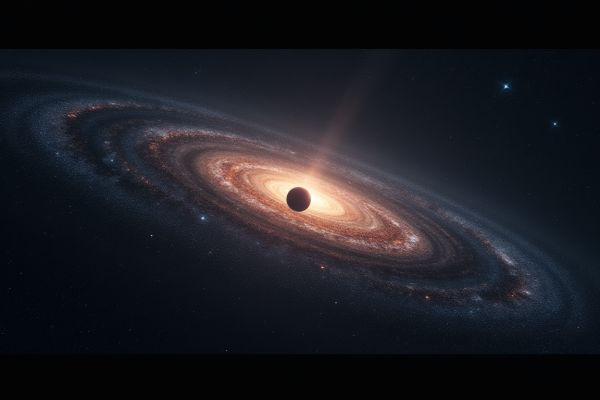
The Most Terrifying Things We Have Discovered in Deep Space
Rogue planets, impossible voids, and stars that could sterilise worlds from thousands of light-years away — the cosmos is stranger and more dangerous than most people realise.
When most people think of space, they picture glittering stars, colourful nebulae, and the quiet majesty of distant galaxies. The reality is far stranger and, in many cases, genuinely unsettling. Over the past two decades, advances in telescope technology and deep-space observation have revealed phenomena that challenge not just our understanding of physics but our sense of safety in the universe.
From a cloud of alcohol floating in space that stretches across 288 billion miles, to a galaxy that is cannibalising its neighbours, the cosmos is full of discoveries that sound like science fiction but are confirmed science fact.
Rogue Planets
Perhaps the most quietly disturbing discovery in modern astronomy is the existence of rogue planets — worlds that drift through interstellar space with no star to orbit. They have been ejected from their solar systems by gravitational interactions and now travel alone through absolute darkness. There is no sunrise, no warmth, no light. Just a frozen sphere hurtling through the void at thousands of kilometres per hour.
In 2020, a study published in the Astronomical Journal estimated that there could be more rogue planets in the Milky Way than there are stars — potentially trillions of them drifting invisibly between solar systems. Some may be Earth-sized. Some may be larger than Jupiter. We cannot see them because they emit no light, which means we only detect them when they pass in front of a distant star and briefly distort its light through gravitational lensing.
There could be more rogue planets in the Milky Way than there are stars — trillions of frozen worlds drifting invisibly through total darkness.
The Bootes Void
Roughly 700 million light-years from Earth lies one of the most perplexing structures in the known universe — the Bootes Void. It is a spherical region of space approximately 330 million light-years in diameter that contains almost nothing. While the surrounding universe is filled with galaxies, clusters, and filaments of matter, the Bootes Void holds only about 60 galaxies where there should be roughly 10,000.
No current model of cosmic evolution fully explains how a void this large could exist. It is not simply empty — it is impossibly empty. Some cosmologists have described it as the single largest known structure in the universe, defined not by what it contains but by what it lacks.
Scale of the Void
Light that entered one side of the Bootes Void when complex life first appeared on Earth still would not have crossed to the other side. That is how vast this emptiness is.
Magnetars
Magnetars are a type of neutron star with magnetic fields so powerful they would be lethal from thousands of kilometres away. A magnetar's magnetic field is roughly one quadrillion times stronger than Earth's. At a distance of 1,000 kilometres, it would disrupt the bioelectric activity in every cell of your body. At closer range, it would rearrange the molecular structure of matter itself — your atoms would be stretched into long thin shapes along the magnetic field lines.
In 2004, a magnetar known as SGR 1806-20 released a burst of energy so powerful that it briefly outshone every star in the Milky Way combined. The blast reached Earth — 50,000 light-years away — and measurably disturbed our upper atmosphere. If a magnetar this powerful existed within 10 light-years of Earth, it could strip away the ozone layer in a single burst.
SGR 1806-20 released more energy in one-tenth of a second than our Sun emits in 100,000 years.
The Great Attractor
Behind the dense band of the Milky Way, in a direction we cannot clearly observe because our own galaxy blocks the view, something enormous is pulling hundreds of thousands of galaxies toward it. This region of gravitational influence is known as the Great Attractor. It sits approximately 150 to 250 million light-years away and exerts a gravitational pull equivalent to the mass of roughly one quadrillion suns.
We cannot see what is there. The Zone of Avoidance — the region obscured by our own galaxy's dust, gas, and stars — blocks visible light from reaching us. Observations in X-ray, infrared, and radio wavelengths have revealed a massive concentration of galaxies, but the exact nature of the Great Attractor remains one of cosmology's great unsolved mysteries.
Hypervelocity Stars
Not all stars remain politely in their orbits. Hypervelocity stars have been flung out of their galaxies at speeds exceeding 1,000 kilometres per second — fast enough to escape the gravitational pull of the entire galaxy. Most are believed to be launched by close encounters with the supermassive black hole at the centre of the Milky Way.
As of 2023, astronomers have identified over 30 hypervelocity stars leaving the Milky Way. They will never return. They are destined to travel alone through intergalactic space for billions of years until they eventually burn out and go dark.
The Cosmic Microwave Background Cold Spot
In 2004, scientists studying the Cosmic Microwave Background — the residual radiation from the Big Bang — discovered an anomalous cold spot in the constellation Eridanus. This region is significantly colder than predicted by standard cosmological models and spans roughly 1.8 billion light-years across.
Several explanations have been proposed, from a supervoid draining energy from photons passing through it, to the genuinely radical suggestion that it could be an imprint left by the collision of our universe with another universe in a multiverse. No single explanation has been confirmed, and the Cold Spot remains one of the most debated anomalies in observational cosmology.
The more we learn about the universe, the more we realise how fragile and unlikely our existence truly is. The conditions required for a planet to support life are extraordinarily precise, and the number of cosmic phenomena capable of ending that life from vast distances is humbling.
— Professor Brian Cox, Physicist and Science Communicator
Perspective
There is a strange comfort in confronting the scale and danger of the cosmos. It reframes every earthly problem as temporary and small. The rogue planets, the magnetars, the impossible voids — they have existed for billions of years before humans and will exist for billions of years after.
Understanding the universe does not diminish us. It places us in context. We are not the centre of anything, and that is not a tragedy — it is a liberation.
Frequently Asked Questions
What is a rogue planet?
How dangerous is a magnetar to Earth?
What is the Bootes Void?
Could the Great Attractor affect Earth?
Are hypervelocity stars common?
What is the CMB Cold Spot?
The universe is not hostile — it is indifferent. The rogue planets do not target us. The magnetars do not aim for us. The void does not hunger. But indifference on a cosmic scale is its own form of terror, and understanding it is its own form of courage.