Some Facts about Ancient Egypt
Ancient Egypt lasted for about 3,000 years, far longer than many famous ancient empires. Its people built a unique ancient civilization around the Nile River, recorded ideas in several scripts, and left monuments that still shape how people picture the ancient past.
Ancient Egypt was never one unchanging society. Its rulers, religious practices, foreign contacts, and daily routines shifted across more than 30 dynasties. Looking at the evidence helps separate real history from popular stories.
Key Takeaways
- Ancient Egypt was a dynamic civilization that evolved over 3,000 years, characterized by significant shifts in leadership, religion, and social structures across more than 30 dynasties.
- The Nile River was the lifeblood of the region, providing fertile "black land" for agriculture, a highway for trade, and the necessary resources to support a centralized government and large-scale state projects.
- Contrary to popular myths, the pyramids were constructed by organized, paid Egyptian laborers and skilled craftspeople rather than enslaved people or extraterrestrials.
- Egyptian society offered women more legal rights than many other ancient civilizations, including the ability to own property, run businesses, and initiate divorce.
- While famous for its monuments and mummies, ancient Egyptian society was also defined by a sophisticated writing system, advancements in medicine and mathematics, and a complex culture that engaged in extensive trade and diplomacy throughout the Mediterranean and Africa.
How the Nile Shaped Ancient Egyptian Civilization
The Nile River made large-scale settlement possible in northeastern Africa. Each year, the predictable floodwaters of the Nile River spread rich dark silt across nearby fields, allowing farmers to plant wheat, barley, flax, beans, and vegetables after the water receded.
Ancient Egyptians called this fertile zone Kemet, or "the black land." The dry desert beyond it was Deshret, the "red land." That contrast shaped where people lived, farmed, buried their dead, and traveled.
The river also worked as a highway. Boats moved grain, stone, people, and trade goods between communities. A strong central government could collect taxes in grain and direct labor for state projects.
A simple timeline helps put this long history in perspective:
- Upper and Lower Egypt united around 3100 BCE.
- The Old Kingdom, about 2686 to 2181 BCE, included the great pyramid age.
- The Middle Kingdom began around 2055 BCE.
- The New Kingdom, about 1550 to 1070 BCE, brought military expansion and powerful rulers.
- Later Egypt came under Libyan, Kushite, Persian, Macedonian Greek, and Roman rule.
Pharaohs were both rulers and religious figures
A pharaoh led the government, commanded armies, approved major building projects, and upheld ma'at, the Egyptian ideal of order and justice. Egyptians also viewed the ruler as a link between people and the gods.
Rulers did not all govern in the same way. Hatshepsut ruled successfully in the 15th century BCE and sponsored major construction at Deir el-Bahari. Akhenaten promoted worship of the Aten, while King Tutankhamun restored older religious traditions after Akhenaten's death. Ramses II led military campaigns, built widely across Egypt, and negotiated a famous peace treaty with the Hittites.
Pharaohs were usually men, but women could rule in their own names. Hatshepsut remains the best-known example, though her path to power was unusual.
Egyptian women rights revealed through society
Royal families and high priests held great wealth, while officials managed taxes, estates, and storehouses. Scribes kept written records. Soldiers guarded borders and joined campaigns. Artisans made furniture, jewelry, tools, statues, and painted tomb scenes.
Most people farmed. During the annual flood, some workers could take part in state labor projects, including canal work and monument construction. Their lives differed greatly from those of palace officials or wealthy priests.
Regarding Egyptian women rights, they held legal status that was uncommon in many ancient societies. They could own property, inherit wealth, make contracts, run businesses, and seek divorce under certain conditions. Real access to power still depended on class, family resources, and local circumstances.
What Ancient Egyptian Religion Says About Pyramids and Mummies
Egyptian religion centered on many Egyptian gods, local traditions, temple rituals, and hopes for the Afterlife. Ra was linked with the sun, Osiris with the dead and rebirth, Isis with protection and kingship, Anubis with embalming, and Horus with royal power. Preparing for the Afterlife was a central motivation for the religious life of the people.
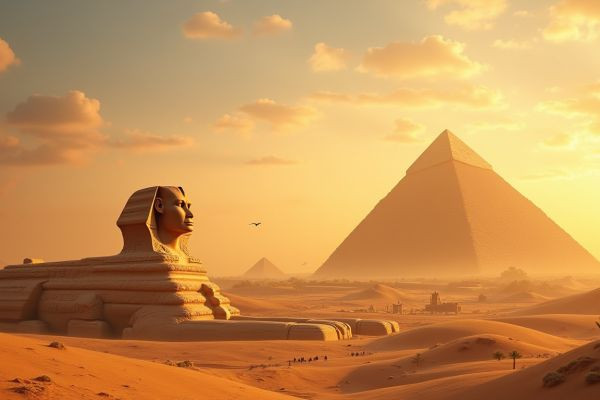
Pyramids were royal tombs built to protect and honor dead kings. The Great Pyramid at Giza was built for Khufu during the 26th century BCE as part of the wider complex known as the Pyramids of Giza. Nearby, the Great Sphinx features a lion body and a human head.
Burial goods could include food, clothing, furniture, jewelry, and protective objects. Texts now called the Book of the Dead contained spells intended to help the deceased move safely through the afterlife. These beliefs were religious convictions, not claims that modern evidence can prove.
Egyptian tombs were built for the dead, yet they also showed the living who held wealth, authority, and sacred status.
The pyramids were planned building projects, not simple piles of stone
Pyramid construction required quarry workers, stonecutters, haulers, surveyors, boat crews, cooks, and administrators. Workers moved limestone and granite with sledges, ropes, ramps, and carefully planned routes.
Archaeologists have found worker housing, bakeries, animal bones, tools, and administrative evidence near Giza. These finds point to paid laborers supported with food and supplies. Some paid laborers likely came through temporary service obligations, while others held specialized roles.
The claim that aliens built the pyramids has no archaeological support. Nor does the old picture of every pyramid worker as an enslaved person. Much about exact building methods remains debated, yet the human organization behind the projects is clear.
Mummification changed over time and was not limited to pharaohs
Mummification aimed to preserve the body for the afterlife. Embalmers removed most internal organs, dried the body with natron salt, wrapped it in linen, and placed it in a coffin or tomb.
Canopic jars often held preserved organs. The quality of treatment varied sharply by wealth. Royal mummies received costly materials and long preparation, while poorer families used simpler methods.
Egyptians also mummified animals, including cats, ibises, crocodiles, and bulls. Some animals were sacred offerings, while others had close ties to particular gods.
Ancient Egyptian Writing, Science, and Everyday Technology
Hieroglyphic writing was a formal system used on monuments, temple walls, and tombs. Symbols could stand for sounds, whole words, or ideas. Hieratic was a faster cursive script, often used for records and letters, while Demotic developed later for everyday administration.
The Rosetta Stone gave scholars a major clue because it carried the same decree in Greek, Demotic, and hieroglyphs. After its discovery in 1799, Jean-Francois Champollion used the text to help decipher these ancient scripts in 1822.
The Egyptians developed a 365-day calendar consisting of 12 months of 30 days plus five extra days. Mathematics helped officials measure fields after seasonal floods and calculate grain accounts. Ancient medicine was documented in specialized papyri, which recorded treatments for injuries and digestive problems, though these practices were often intertwined with spells and religious rituals.
Tools supported daily work throughout the region. Boats carried goods along the Nile, and farmers used irrigation channels and shadufs, which were devices that lifted water with a counterweighted pole.
Scribes kept records that helped the state function
Literacy was limited, so scribes held highly respected positions. Their work supported royal estates, temples, military units, and courts.
They wrote tax lists, grain accounts, legal contracts, letters, religious texts, and medical instructions. Egyptians typically wrote on papyrus, stone, pottery fragments called ostraca, coffins, and temple walls. A written grain account could matter as much to a household as a carved royal inscription.
Food, clothing, homes, and games reveal daily life
Bread and beer formed the base of many diets. People also ate onions, dates, fish, beans, figs, and vegetables. Wealthier households had greater access to meat, wine, and imported foods.
Many families lived in mud-brick homes furnished with storage jars, grinding stones, and wooden furniture. Linen clothing was perfectly suited for the hot climate of the region. Makeup and cosmetics served both practical and ritual purposes, protecting the skin and eyes while holding deep social meaning. Jewelry, music, and board games such as senet appeared in homes across several social levels, though the materials and quality varied.
Facts That Correct Common Myths About Ancient Egypt
Several familiar claims flatten a long and varied history.
- Myth: Pyramids were built by aliens. Fact: Archaeological evidence confirms that the Pyramids of Giza were constructed by dedicated Egyptian planners, craftspeople, and paid laborers supported by robust supply networks.
- Myth: Every Egyptian was enslaved. Fact: Farmers, artisans, officials, and laborers occupied different positions within the social hierarchy. While Egypt did utilize enslaved people at times, slavery does not define the entirety of their society.
- Myth: All pharaohs were men. Fact: Powerful women like Hatshepsut and several others held royal power throughout the dynastic periods.
- Myth: Hieroglyphs were only pictures. Fact: Many signs functioned as phonetic elements that recorded complex sounds and grammar.
- Myth: Cleopatra lived during the pyramid age. Fact: Cleopatra VII ruled much later, from 51 to 30 BCE.
Cleopatra VII belonged to the Ptolemaic Dynasty, a Macedonian Greek royal family that took control of Egypt following the conquest of Alexander the Great. By the time of her reign, the Great Pyramid was already more than 2,400 years old.
Ancient Egyptians referred to their country as Kemet, while the English name Egypt evolved through Greek and later Roman usage.
Ancient Egypt was connected to Africa and the wider Mediterranean world
Ancient Egypt was a sophisticated ancient civilization with deep African roots and strong ties across the Nile Valley. It traded and engaged in diplomacy or conflict with Nubia and Kush to the south, exchanged goods with the Levant, and sought valuable materials from Punt, which was likely located south or southeast of the region.
The Kushite kings of the Twenty-Fifth Dynasty ruled Egypt during the 8th and 7th centuries BCE. Rulers such as Taharqa demonstrate that the history of this ancient civilization included powerful African kingdoms, significant migration, and constant cultural exchange.
Why Ancient Egypt Still Matters Today
Records from Ancient Egypt provide historians with remarkable detail about government, religion, family life, medicine, work, and art. Museums and archaeological sites preserve this evidence, yet such preservation carries significant responsibilities. Human remains and sacred objects deserve care, proper context, and respect.
Frequently Asked Questions
When did Ancient Egypt begin?
The civilization of Ancient Egypt began around 3100 BCE, when the regions of Upper and Lower Egypt were united under the rule of a single pharaoh.
Why was the Nile so important to Egypt?
The Nile River was essential because it supplied water, fertile soil, fish, reliable transport routes, and a consistent foundation for agricultural production.
Who built the pyramids?
Egyptian laborers, skilled craftspeople, engineers, and administrators built these structures through highly organized state projects.
What were hieroglyphs?
Hieroglyphic writing was a complex system that utilized various signs and symbols to represent specific sounds, words, and abstract ideas.
Why did Egyptians make mummies?
They preserved bodies because they maintained a deeply held belief that the soul required its physical form to survive in the afterlife.
Who was Cleopatra?
Cleopatra VII was the final active ruler of Ptolemaic Egypt. She commanded the throne from 51 to 30 BCE.
Did women have rights in Ancient Egypt?
Legal status regarding Egyptian women rights was surprisingly progressive for the era, as many women could own property, execute contracts, inherit wealth, and initiate a divorce.
The Evidence Behind Ancient Egypt's Famous Stories
The Nile supported the farms and towns of the region, while an organized government made massive building projects possible. Religious beliefs shaped the design of temples, tombs, mummies, and art. Furthermore, writing preserved historical details that would otherwise be lost, including receipts, letters, medical texts, and prayers.
Ancient Egypt changed significantly across thousands of years. While the culture's famous monuments, such as the Great Pyramid, capture our imagination today, the daily work, family life, trade, and local beliefs of the people mattered just as much to their civilization. The strongest accounts of Ancient Egypt compare popular stories with archaeological finds and surviving written evidence, ensuring we maintain an accurate understanding of Ancient Egypt for generations to come.