Some Facts About Ocean Life
Earth's ocean covers more than 70% of the planet, yet much of it remains hard to reach and study. The study of marine life reveals microscopic plankton, colorful reef fish, giant squid, and blue whales, all living under very different conditions. This massive environment supports incredible biodiversity.
TL;DR: The ocean holds habitats ranging from bright coral reefs to deep trenches with no sunlight. Marine animals survive cold, pressure, salt water, and scarce food through specialized adaptations. Warming, pollution, overfishing, and acidification threaten these systems, but human choices and science-based protections can help.
The facts become more interesting once you see how closely every ocean habitat is connected.
How Large and Deep Is the Ocean?
Oceans cover about 71% of Earth's surface and contain roughly 97% of its water. They are not one uniform body of water. Light, temperature, pressure, and food supply change sharply as depth increases.
Near the surface, sunlight reaches the water and supports photosynthesis. Below that bright layer, the ocean becomes dim, cold, and eventually pitch-black. The seafloor includes underwater mountains, plains, canyons, and trenches.
The Mariana Trench in the western Pacific reaches nearly 11,000 meters below sea level. At those depths, pressure is extreme, making it a challenging environment for deep sea exploration. A human body could not survive there without a specially built submersible.
Life Exists Between Tidal Pools and the Deep Sea
Ocean habitats include estuaries, mangrove forests, seagrass beds, coral reefs, open water, polar seas, and hydrothermal vents. Each one has its own temperature, salinity, and variety of marine life, along with unique currents and food sources.
Tidal pools may heat up during the day and cool quickly at night. Estuaries mix fresh river water with saltwater, so animals living there must cope with changing salt levels. Mangrove roots shelter young fish, while coral reefs give small animals places to hide.
Deep-sea animals live without sunlight. Many feed on particles and dead organisms that sink from surface waters. Near hydrothermal vents, life depends on chemical energy instead.
Tiny Plankton Support Much of the Ocean Food Web
Plankton are organisms that drift with ocean currents. Phytoplankton are tiny plant-like organisms that use sunlight and carbon dioxide to make food. These organisms are vital to global oxygen production, as they release a large share of the oxygen produced on Earth.
Zooplankton are drifting animals or animal-like organisms. They eat phytoplankton and become food for krill, fish, shellfish, seabirds, and whales.
A blue whale may weigh more than 150 metric tons, yet it depends mainly on krill. That food chain begins with tiny organisms floating near the surface.
Much of ocean life depends on organisms too small to see without a microscope.
How Ocean Animals Survive in Extreme Conditions
Salt water pulls moisture from bodies, cold water drains heat, deep water creates crushing pressure, and open water may offer few hiding places. Marine animals meet these challenges with body shapes, behaviors, senses, and internal chemistry suited to their habitats.
Camouflage, Body Shapes, and Special Senses
An octopus can change its color and skin texture to blend into rocks, sand, or coral. Other invertebrates, such as seahorses and jellyfish, have evolved specialized forms to hide from predators or ambush prey in open water. Flatfish, such as flounder, often bury themselves in the seafloor while waiting for a meal.
Tuna and dolphins have streamlined bodies that reduce drag for high-speed swimming. Sharks often use countershading, with darker backs and lighter bellies, which makes them harder to spot from above or below.
Toothed whales, including dolphins and sperm whales, use echolocation. They produce clicks and interpret returning echoes to locate prey and judge distance accurately in murky water.
In the deepest, darkest reaches of the ocean, some animals create their own light through bioluminescence. An anglerfish uses a glowing lure near its mouth to attract prey, while flashlight fish carry light-producing bacteria beneath their eyes to signal in the darkness.
How Marine Mammals and Fish Handle Cold Water
Marine mammals like whales and seals rely on thick layers of blubber to slow heat loss. Their large body size also helps, as larger animals lose heat more slowly than smaller ones.
Some Antarctic fish make antifreeze proteins that keep ice crystals from growing inside their bodies. Without those proteins, their tissues could freeze in water that stays below the usual freezing point of fresh water.
Fish pull dissolved oxygen from water through gills. Whales and dolphins are marine mammals, so they must breathe air through blowholes. They are required to return to the surface periodically, even when they hunt deep below it.
Hydrothermal Vents Run on Chemical Energy
Hydrothermal vents form where heated seawater rises through cracks in the seafloor. The vent fluid contains chemicals, including hydrogen sulfide, that would be dangerous for many animals.
Certain bacteria use those chemicals to make food through chemosynthesis. This process does not need sunlight. The bacteria support communities of giant tube worms, clams, crabs, and specialized shrimp.
Giant tube worms have no mouths or stomachs. Instead, bacteria living inside them provide much of their nourishment. Vent communities show that food webs can begin with chemical energy rather than sunlight.
Ocean Ecosystems Connect Every Kind of Marine Life
Energy moves through complex marine food webs. Producers such as phytoplankton and algae create the foundation of the food chain. Herbivores and small predators consume them, while larger animals feed higher in the system. Coral reefs, kelp forests, mangroves, and open-ocean waters each support unique communities, ensuring that all marine life remains interconnected. Even dead material serves a purpose, as scavengers and decomposers return vital nutrients to the ecosystem.
Coral Reefs Are Small Areas With Many Species
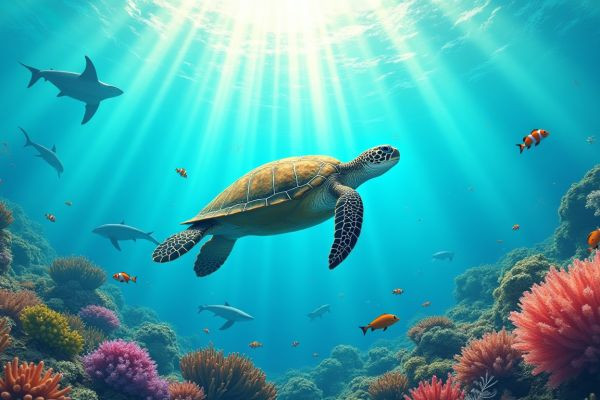
Coral reefs cover less than 1% of the seafloor, yet they provide a critical habitat for roughly one-quarter of all marine species. A diverse array of reef fish, crustaceans, mollusks, and sea turtles depend on these crowded, vibrant environments to survive and thrive.
Coral is not a plant. A reef is actually built by colonies of tiny animals called coral polyps. Many corals live in symbiosis with microscopic algae that provide food through photosynthesis. When water stays too warm, corals can expel those algae. The coral then turns pale or white, a condition called bleaching. A bleached coral may recover if conditions improve quickly, but repeated heat stress can be fatal to the colony.
Kelp Forests, Mangroves, and Seagrass Protect Coastlines
Kelp forests grow in cool, nutrient-rich coastal waters. Their tall, dense fronds create essential shelter for various fish and invertebrates, while sea otters help maintain the balance by hunting sea urchins that might otherwise overgraze the area.
Mangroves grow along tropical and subtropical coasts. Their tangled roots effectively reduce wave energy and provide juvenile fish with a protected nursery to grow. Seagrass beds perform similar work in shallow waters. These coastal habitats support commercial fisheries, help reduce erosion, store carbon, and trap sediment that could otherwise cloud the water. The loss of these environments negatively impacts both wild species and nearby human communities.
Predators and Decomposers Keep the Food Web Moving
Apex predators can shape an entire ecosystem without eating every individual species within it. For example, sea otters limit sea urchin populations in many kelp forests, which allows more kelp to survive. Similarly, great white sharks and killer whales influence where prey animals feed and gather, creating a "landscape of fear" that prevents overgrazing in certain zones. Sea stars eat mussels and other animals attached to rocks, which directly changes the variety of species found on a shore.
Bacteria, fungi, worms, and various scavengers break down dead plants and animals to recycle nutrients that support new growth. When one species disappears from these webs, the ecological connections can shift in unexpected and often damaging ways.
The Biggest Threats to Ocean Life and What Helps
Human activity places pressure on the ocean in several ways. NOAA and other scientific agencies report that the ocean has absorbed about 90% of the excess heat linked to recent climate change.
Warmer water harms coral reefs and shifts where fish can live. Carbon dioxide entering seawater changes its chemistry. Pollution, destructive fishing, and habitat loss add further stress to vulnerable marine life.
Warming, Acidification, and Low-Oxygen Zones
As seawater warms, it expands and contributes to sea-level rise. Heat can also disrupt breeding, migration, and food supply for marine animals.
Carbon dioxide dissolves in seawater and lowers its pH, a process called ocean acidification. This can make it harder for oysters, clams, corals, and some plankton to build or maintain shells and skeletons.
Dead zones are areas with very low oxygen. Fertilizer runoff and sewage can fuel algae growth. When algae die and decompose, bacteria consume oxygen that fish and other animals need.
Plastic Pollution, Fishing Pressure, and Habitat Loss
Plastic pollution can entangle seals, sea turtles, marine mammals, and fish. Animals may mistake bags, fragments, or balloons for food. Lost fishing gear can continue trapping wildlife for years.
Overfishing removes animals faster than populations can recover. Bycatch catches non-target species, including dolphins and seabirds. Bottom trawling can damage seafloor habitats when heavy nets drag across them.
Coastal development can remove mangroves, reefs, wetlands, and seagrass. Healthy shore habitats need room for tides, sediment, and young marine animals.
Actions That Support Healthier Seas
Individual actions matter most when they become common habits and support larger public efforts.
- Use fewer single-use plastics, and keep litter away from storm drains, rivers, and beaches.
- Choose seafood from well-managed fisheries when possible.
- Reduce household energy use, since fossil fuel emissions drive ocean warming and acidification.
- Follow wildlife-viewing rules, keep distance from animals, and never feed them.
- Support local habitat restoration, beach cleanups, protected areas, and strong pollution controls.
Long-term progress also requires better fishing practices, scientific monitoring, protected habitats, and climate action.
Common Questions About Ocean Life
What Is the Largest Animal in the Ocean?
The blue whale is the largest known animal ever to live. Adults can reach about 30 meters long and weigh roughly 150 to 200 metric tons. Despite that massive size, these giants feed mainly on tiny krill.
How Many Species Live in the Ocean?
Scientists have described hundreds of thousands of marine species. The total remains unknown because many organisms dwelling in the deep sea, along with microscopic and remote area species, have not yet been identified.
What Animal Lives Deepest in the Ocean?
Hadal snailfish have been recorded at depths greater than 8,000 meters in ocean trenches. While these fish hold records, the ocean remains home to a massive variety of creatures, from the clever octopus to migratory sea turtles, each adapted to their specific niche.
Why Is the Ocean Salty?
Rain and rivers wear minerals from rocks and carry dissolved salts to the sea. Seafloor vents and volcanic activity add minerals as well. Evaporation removes water while leaving salts behind.
Do All Ocean Animals Live in Salt Water?
Most marine animals are adapted to salt water. Some species, such as certain types of seahorses that frequent brackish estuaries, or salmon, eels, and some sharks, move between fresh and salt water. They use osmoregulation to control water and salt levels inside their bodies.
Why Is Ocean Life Important to People?
Marine life provides food, jobs, coastal protection, climate regulation, recreation, and materials used in medicine. Ocean photosynthesizers also contribute heavily to the oxygen supply for all life on Earth.
Final Thoughts
Ocean life is varied, highly adapted, and connected through food webs that begin with plankton, algae, or chemical energy. A reef fish, a deep-sea tube worm, and a blue whale all depend on healthy conditions in their own unique ways.
Small daily choices can reduce pollution and protect wildlife. However, larger gains depend on establishing protected habitats, improving coastal practices, supporting responsible fisheries, and taking meaningful action on climate change. We must prioritize the preservation of diverse marine life and fragile environments like coral reefs, as the ocean is a living system rather than an unlimited resource.