
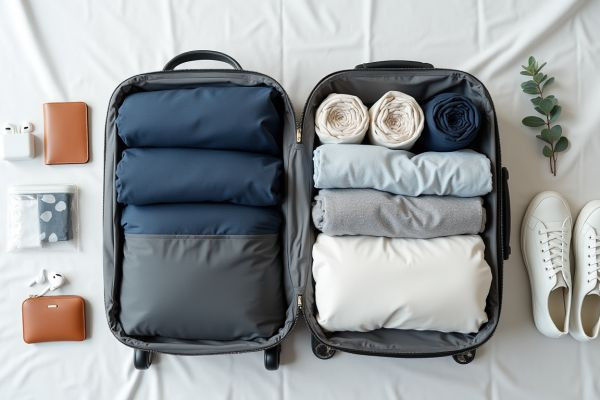
How to Pack Light for Any Trip — The Complete 2026 Guide
Stop checking bags, skipping queues, and paying excess fees — everything you need to travel carry-on only, to any destination, for any length of trip.
5 min read Travel Guide Practical TipsContents
Jump to BottomQuick Summary
- The right bag is the foundation — a 40L backpack handles 95% of trips carry-on only
- A capsule wardrobe of 9 items covers every outfit combination you need for 2 weeks
- Solid toiletries and mini decants eliminate liquid restrictions and half your bag weight
- One universal travel adapter and a phone replace most electronics people over-pack
- The packing light mindset is a skill — it gets easier and faster every trip you take
40L is enough
A well-packed 40-litre backpack handles any trip from a weekend to three months
9 items, infinite outfits
A capsule wardrobe built around neutrals creates more combinations than a full suitcase
Skip every queue
No check-in, no baggage claim, no lost luggage — straight off the plane and out the door
Most people pack for the trip they're afraid of rather than the trip they're actually taking. They bring three pairs of shoes for a city break, four jumpers for a beach holiday, and an entire pharmacy for a two-week trip to a country with pharmacies on every corner. The result is a bag that controls them rather than a bag they control.
Packing light is not about deprivation. It's about intentionality — bringing exactly what you need, in forms that work hardest, chosen to cover the most situations. Once you've done it once, you'll never go back to checking a bag.
1. Choose the Right Bag
Your bag determines your packing behaviour more than anything else you own. A large rolling suitcase will always get filled — even if you started with the best intentions. A well-chosen carry-on backpack creates a natural constraint that forces better decisions from the start.
The sweet spot for most travellers is a 35–45 litre backpack that fits within carry-on dimensions for the strictest airlines (typically 40×20×25cm for budget carriers). Brands like Osprey, Peak Design, and Minaal build bags specifically engineered for this purpose with clamshell openings that make packing and access dramatically easier than top-loading bags.
What to Look For
- 35–45L capacity — the universal carry-on sweet spot
- Clamshell opening — access everything without unpacking
- Hip belt or sternum strap — weight distribution on longer walks
- Laptop compartment that passes security without removal
- External dimensions within strictest airline carry-on rules
What to Avoid
- Bags over 45L — they'll be gate-checked anyway
- Top-loading only — you'll unpack everything to find anything
- Heavy bag construction — the bag itself eats your weight allowance
- Wheels on a backpack — worst of both worlds
2. Build a Capsule Wardrobe
The capsule wardrobe principle applied to travel is simple: every item must work with every other item, every item must serve multiple purposes, and the colour palette must be limited to neutrals that mix freely. Nine clothing items — chosen carefully — create more outfit combinations than a suitcase stuffed with 25 uncoordinated pieces.
The Core 9-Item List
- 3 t-shirts or tops (merino wool or synthetic — quick-dry, odour-resistant)
- 1 long-sleeve shirt (doubles as a light layer and smarter option)
- 2 bottoms (one casual, one slightly smarter — both neutral)
- 1 mid-layer (lightweight fleece or merino jumper)
- 1 outer layer (packable down jacket or waterproof shell depending on destination)
- 1 pair of shoes that walk all day AND look acceptable for dinner
The best bag you'll ever own is the one you never have to check. Everything else is just packing.
3. Master Your Toiletries
Toiletries are where most light packers fail. The liquids rule catches people out, and the instinct to bring full-size products "just in case" adds kilograms of dead weight for items available in any pharmacy worldwide.
Go Solid
- →Solid shampoo bar — no liquid rules
- →Solid conditioner bar — lasts 50+ washes
- →Solid soap — replaces body wash entirely
- →Solid sunscreen — passes any security
- →Toothpaste tablets — no tube, no mess
The solution is two-pronged. First, switch as many products as possible to solid formats — solid shampoo bars, conditioner bars, soap, and even sunscreen eliminate liquid restrictions entirely and weigh a fraction of their bottled equivalents. Second, for anything that must be liquid, decant into 30ml reusable containers and buy replacements locally if you run out.
4. Slim Down Your Electronics
Electronics are the fastest-growing category of over-packing. People bring laptops, tablets, e-readers, cameras, multiple chargers, power banks, travel routers, and cable collections that weigh more than their clothing. Ask honestly whether each device will actually be used — and whether the phone already does what you think it can't.
Usually Worth Bringing
- Phone (replaces camera, map, guide, translator)
- Universal travel adapter (one covers everything)
- Small power bank (10,000mAh is plenty)
- Laptop — only if you'll genuinely work
- Noise-cancelling earbuds (not full headphones)
Usually Leave Behind
- Tablet — phone or laptop covers both
- Dedicated camera — unless photography is the trip
- Multiple chargers — one USB-C hub charges everything
- Travel router — hotel WiFi or a local SIM works fine
- Full-size headphones — earbuds weigh nothing
5. The Packing Light Mindset
The practical changes above are straightforward. The harder shift is mental. Most over-packing stems from anxiety — the fear of not having something rather than a realistic assessment of what you'll need. Every "just in case" item represents a failure of confidence in your own resourcefulness and the world's ability to provide.
Three questions cut through packing anxiety immediately: Have I used this on a previous trip? Could I buy this locally if I genuinely needed it? Would I carry this for 20 minutes through an airport at the end of a long day? If the answer to all three is no — leave it behind.
Pack everything out on your bed first
Lay out everything you think you want to bring. Then put half of it back. The items you hesitate over longest are usually the ones you need least.
Track what you actually use
On your first light-packing trip, note every item you use and every item you don't touch. Most travellers find they use 60% of what they bring and could eliminate the rest on the next trip.
Refine on every trip
Packing light is a skill that compounds. Each trip you learn something new — an item that can be left behind, a format that works better, a local purchase that saved space. After five trips your system will be genuinely excellent.
The right bag, nine versatile clothing items, solid toiletries, and a ruthlessly edited electronics kit is everything you need for any trip. The anxiety that drives over-packing disappears after your first successful carry-on journey — and once it's gone, it never comes back.