
SEO & GEO Strategy · 2026
How to Build a Content Cluster That Dominates Both Google and AI Search
One architecture. Two search systems. Compounding authority that builds automatically as your cluster grows.
Key Takeaways
- A content cluster is a pillar page plus 15–30 interconnected cluster articles covering every subtopic angle.
- 25+ cluster articles produces a 40–70% keyword ranking increase within 3–6 months.
- The same structure that wins in Google also wins AI citation — comprehensive topical coverage is the shared signal.
- Write the pillar page first. Cluster articles come after the framework is set.
- FAQPage mainEntity schema on every cluster article gives AI engines machine-readable Q&A data to cite directly.
In This Guide
A content cluster is a group of interconnected articles built around one central pillar page, designed to establish your website as the authoritative source on a specific topic. Sites that publish at least 25 tightly connected cluster articles see 40 to 70 percent increases in keyword rankings within three to six months — and AI search engines follow the same pattern, favouring sites with comprehensive, interconnected topic coverage when deciding what to cite.
Most websites publish articles in no particular order with no structural connection between them. A tutorial here, a review there, an opinion piece whenever inspiration strikes. This approach produces a collection of content, not authority. In 2026, authority is the only currency that matters in both traditional and AI search — and a content cluster is how you build it deliberately.
One Architecture
The hub-and-spoke cluster model produces both Google topical authority and AI citation credibility simultaneously. Build it once.
Compounding Returns
Each new cluster article reinforces every other. A 30-article cluster is not twice as powerful as 15 — it is exponentially more authoritative.
Multiple Entry Points
Every cluster article is a potential AI citation point for a different query. 25 articles means 25 ways to be cited across 25 different questions.
Understanding Content Clusters
What is a Content Cluster and How Does It Work?
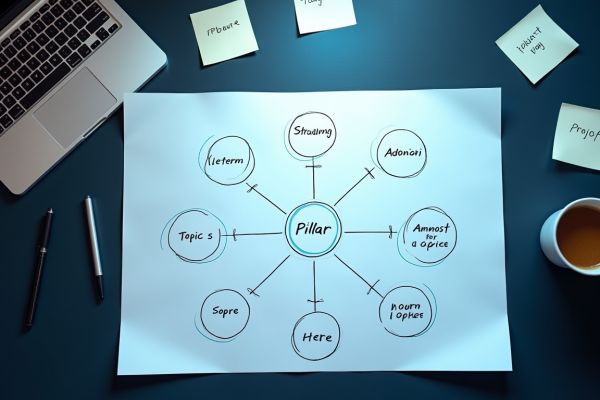
A content cluster consists of three structural elements working together. The pillar page is a comprehensive, long-form page of 3,000 to 5,000 words covering the main topic broadly, with links out to each cluster article. The cluster articles are 15 to 30 supporting pieces, each going deep on one specific subtopic. The internal link web connects everything — every cluster article links back to the pillar, and cluster articles link to each other where relevant.
When a search engine or AI system encounters your cluster, it finds a website that does not just mention a topic once — it covers it from every angle, answers every related question, and demonstrates sustained, deep expertise. This is what topical authority looks like to an algorithm.
Why Both Systems Respond
Google rewards topical depth and comprehensive coverage. AI engines cite the most trustworthy, complete source they can find. Both signals are produced by the same cluster architecture. You do not need two separate strategies — you need one done properly.
Why Does This Structure Work for Both Google and AI Search?
Google’s algorithm has been moving toward topical authority for years. The Helpful Content Update and successive core updates have consistently rewarded sites demonstrating depth and expertise. A well-built cluster signals to Google that your site is a genuine authority, not a keyword-targeting exercise.
AI search engines work differently but reward the same thing. When ChatGPT, Perplexity, or Gemini processes a query on your topic, it searches for the most comprehensive, trustworthy source available. A site with 25 interconnected articles covering every aspect of a topic is far more likely to be selected as a citation source than a site with one excellent article on the same subject.
The work you do to build topical authority for Google simultaneously builds the citation credibility AI engines require. One architecture. Two search systems. Compounding returns.
Phase 1 — Planning Your Cluster
How Do You Choose the Right Pillar Topic?
The pillar topic is the most important decision in the process. The right pillar topic has three characteristics:
1. Specific Enough
“Marketing” is not ownable. “Email marketing for SaaS companies” is. Specificity accelerates authority accumulation and makes AI classification more precise.
2. Broad Enough
Before committing, write out 30 potential cluster article titles. If you struggle to reach 20, the topic is too narrow. If every title sounds the same, it lacks breadth.
3. Genuinely Yours
Choose a topic where you can produce genuinely authoritative content, and where there is a clear audience asking questions you can answer. Volume follows authority.
How Do You Map Your Cluster Articles?
Use five question categories to generate your 25-plus cluster article titles. This approach almost always produces 25 to 40 distinct article ideas per pillar topic:
- 1Definition & background questions
"What is X?", "How does X work?", "What are the types of X?" — introductory articles for awareness-stage readers.
- 2How-to & step-by-step questions
"How do you do X?", "What are the steps to X?" — practical guides for readers ready to act.
- 3Comparison & decision questions
"X vs Y", "What is the difference between X and Y?" — comparison articles for readers evaluating options.
- 4Problem & solution questions
"Why is X not working?", "How do you fix X?" — troubleshooting articles for readers facing specific challenges.
- 5Advanced strategy questions
"How do professionals use X?", "How do you scale X?" — expert-level articles for experienced readers seeking more.
Phase 2 — Building the Pillar Page
What Makes an Effective Pillar Page?
The pillar page has one job: establish your site as the definitive resource on the topic. It should be comprehensive but not exhaustive — it covers every major aspect and links out to cluster articles for the deep dives.
Critical structural rules
- → Open with a direct answer to the main question the topic implies — in the first two sentences
- → Cover every major subtopic area with a substantive section, then link to the cluster article for depth
- → Include at least five specific data points, statistics, or quantified claims
- → Write the pillar page first — before any cluster articles. It sets the quality standard for everything that follows
The most common mistake is building the pillar page last — assembling it from existing cluster content. This produces weak pillar pages that aggregate rather than lead. Write the pillar page first. It defines the cluster’s shape, scope, and authority standard.
Write the pillar page first. It sets the quality standard and structural framework for every cluster article that follows. Build the foundation before the floors.
Phase 3 — Creating Cluster Articles
How Should Each Cluster Article Be Written?
Every cluster article has one specific role: go deep on one subtopic that the pillar page introduces. Four rules apply to every article in your cluster without exception:
Answer First
The first sentence must answer the specific question the article title implies. AI engines extract opening paragraphs first. This is the most cited section of any article.
Question-Based Titles
Use the question format where natural: "How to Build an Email List" rather than "Email List Building Guide." Matches AI prompt patterns and increases citation retrieval.
Specific Data
Articles with specific benchmarks, named comparisons, and quantified results are cited by AI engines far more often than articles covering the same topic in general terms.
FAQPage Schema
Every cluster article needs a FAQ section with FAQPage mainEntity schema encoding every Q&A pair as structured data. AI engines cite this directly without needing to parse the full article.
Growth Principle
Update cluster articles quarterly. AI citation frequency drops sharply for content older than three months. Monitor Perplexity.ai monthly — search your article titles to see which are being cited and which are not. Articles not being cited despite strong content often have structural issues: buried answers, vague headings, or missing FAQ schema. Fix the structure first.
Phase 4 — The Internal Linking Architecture
How Should You Structure Internal Links Within a Cluster?
Internal linking transforms a collection of related articles into a genuine content cluster. Without intentional links, you have topically related content but not topical authority.
| Link Type | Rule | Anchor Text |
|---|---|---|
| Cluster → Pillar | Every cluster article links back to the pillar | Descriptive: “complete guide to [topic]” |
| Pillar → Cluster | Pillar links to every cluster article | Describes what the cluster article covers |
| Cluster → Cluster | Link to 3+ related cluster articles per piece | Only where connection genuinely helps reader |
Warning: Do not link everything to everything. Every internal link should answer: would a reader genuinely benefit from navigating to this linked page from here? Forced links signal low quality to both Google and AI engines.
Myths vs Facts About Content Clusters
Myth
You need to publish all cluster articles simultaneously for the strategy to work.
Fact
Clusters can be built incrementally. Publish the pillar, release five to seven cluster articles, then expand steadily over months. What matters is eventual interconnection, not timing.
Myth
More articles in a cluster always means more authority.
Fact
20 tightly focused, data-rich cluster articles consistently outperform 50 thin articles on the same topic. Build for depth first, then expand.
Myth
Content clusters only work for broad, high-volume topics.
Fact
The model is particularly effective for niche topics where comprehensive coverage is rare. A niche site with 25 authoritative articles can establish AI citation authority faster than a broad topic site competing against hundreds of established sources.
Frequently Asked Questions
How many cluster articles do you need before seeing results?
Should cluster articles target individual keywords?
Can you have multiple content clusters on one website?
How do you handle overlapping topics between cluster articles?
How long should a cluster article be?
Tools & Resources
Cluster Planning
Ahrefs / Semrush — topic cluster mapping and content gap analysis to identify your 25+ cluster article titles.
Question Research
AnswerThePublic — visual map of questions, prepositions, and comparisons around any seed topic.
Internal Link Audit
Screaming Frog — maps your internal link structure and identifies pages with insufficient connections. Run quarterly.
AI Citation Monitoring
Perplexity.ai — search your pillar topic and article titles monthly to track AI citation appearances.
A content cluster is not a content project. It is a search architecture decision. The same structure that tells Google you are the definitive authority on a topic also tells ChatGPT, Perplexity, and Gemini who to cite when someone asks about it. Start by choosing your pillar topic and writing out 30 potential cluster article titles. If you can do that, you have everything you need to begin building authority that compounds.